Ryuuji Morisaki
5 Centimeters per SecondRyuuji Morisaki enters the story in two sharply different roles: a bespectacled substitute teacher in Asuna Watase’s classroom and a Commander in the Arch Angels pursuing a way into Agartha. Beneath that concealed identity, however, is a single, consuming purpose. He seeks not immortality or ancient knowledge, but the return of his dead wife, Lisa. His attempt to reach her makes him central to the story’s conflict over resurrection, and the cost of that attempt leaves him confronting the very loss he hoped to undo.
Identity and Two Roles
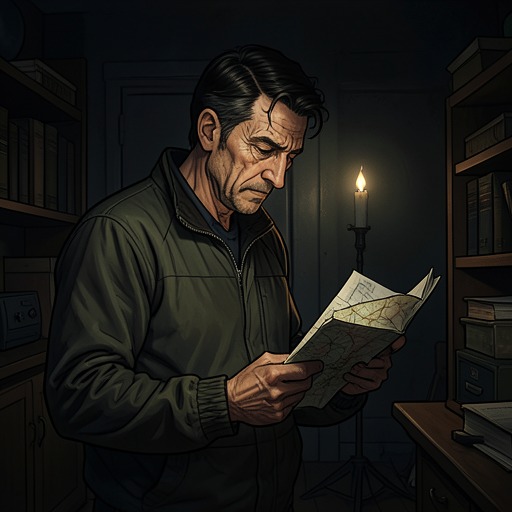
Morisaki first appears at school after Ms. Ikeda goes on maternity leave. He is described as severe-looking and bespectacled; the boys grumble that their new teacher is not a woman, while the girls find him handsome. Asuna is too preoccupied with the possibility that Shun is dead to share their interest. The ordinary school introduction therefore unfolds beside Asuna’s fear of loss, a concern that will become closely bound to Morisaki’s own story.
Away from the classroom, Morisaki lives alone in an old apartment building. He types a report in a foreign language on a typewriter that can produce only the Latin alphabet. The report is not schoolwork: it is addressed to the organization that calls him Commander Morisaki. The contrast between the temporary teacher and the commander is not simply a change of setting. His school identity gives him a place in Asuna’s everyday life, while his concealed work connects him to the effort to reach Agartha.
The Purpose of His Search
Morisaki’s aim becomes explicit when Asuna encounters him in the passage toward Agartha. After a boy challenges the Arch Angels’ hopes for the ruined land, Morisaki removes his mask, and Asuna recognizes her teacher. He rejects the pursuit of immortality and ancient wisdom as his own motives. What he wants is to resurrect his wife. The revelation reframes his expedition: Agartha is not merely a source of secrets to him, but the place where he believes he may recover the person whose absence has shaped his life.
The determination is visible in the way he speaks of that goal. Asuna recognizes that her teacher really does intend to bring his wife back, and Morisaki’s unwavering resolve persists even as the boy warns that Agartha is falling into ruin. His purpose is intensely personal, but it places him within a larger struggle over what the hidden land can offer and what its power may demand. The strength of his commitment does not make the wish safe; instead, it helps carry him toward a choice whose cost he has not yet understood.
The Price of Resurrection
Morisaki learns about that cost from Nami, who asks whether he knows the price of resurrection. When she explains that the required payment varies with the time, situation, and individual, he hesitates before asking whether this is why Eve is absent. Nami slowly confirms the connection: the price of bringing her back was Eve’s life. Her account makes the danger more than a warning about an unknown ritual. It gives Morisaki a specific example of resurrection joining one person’s return to another person’s loss.
The revelation places his determination under a new pressure. Nami’s experience does not persuade him to abandon Lisa, but it shows that returning the dead is not a simple reversal in which everything lost is restored. For Asuna, the exchange is cruel; for Morisaki, the question is whether the desire to live again with Lisa can be separated from the harm such a desire may bring. The evidence does not make the price predictable. Nami says it varies, leaving Morisaki to proceed without certainty about what his own attempt will require.
The Attempt and Reunion
At the Gate of Life and Death, Morisaki recognizes the black sphere from texts he has read in an old man’s library. He recalls that he has never forgotten Lisa and that he tried once to get over her death, but could not find meaning in a world without her. He then makes his wish with all his fervor. The moment brings his private grief into direct contact with the power he has pursued: what began as a hidden objective becomes an irreversible act.
Afterward, Morisaki walks toward Asuna, whom the narration also identifies with Lisa in that moment. Shin calls on him to change Asuna back, then notices Morisaki’s eyes. Morisaki replies that it is too late and that he has paid his dues. His vision is red-tinged and hazy, yet he can see the woman he loves. Lisa touches his cheeks and remarks that he looks older. Morisaki cannot hold back his tears. The reunion is real, but it does not restore the earlier world: Lisa’s return is accompanied by a visible consequence for him, while Asuna’s presence in the scene makes the cost immediate for those around them.
Loss and the Ending
Morisaki’s grief does not end with seeing Lisa again. He asks Shin to kill him, but Shin refuses. Instead, he relays what his brother Shun said: loss must be embraced, and life must continue. The counsel answers Morisaki’s despair without pretending that the reunion has repaired everything. It turns the scene away from another act of escape and toward the possibility of enduring what cannot be made whole.
As the Shakuna Vimana flies away between the clouds, Morisaki’s tears fall on Asuna’s cheeks and she slowly opens her eyes. Asuna then gently hugs him. Her return to awareness follows Morisaki’s plea for death and Shin’s insistence on continuing to live; the sequence links his private catastrophe to the survival of another person. Morisaki’s arc thus makes resurrection both fulfillment and failure: he reaches Lisa, but the encounter does not erase grief or free him from its consequences. His final position is shaped by the difficult distinction between keeping love alive and trying to cancel loss altogether.